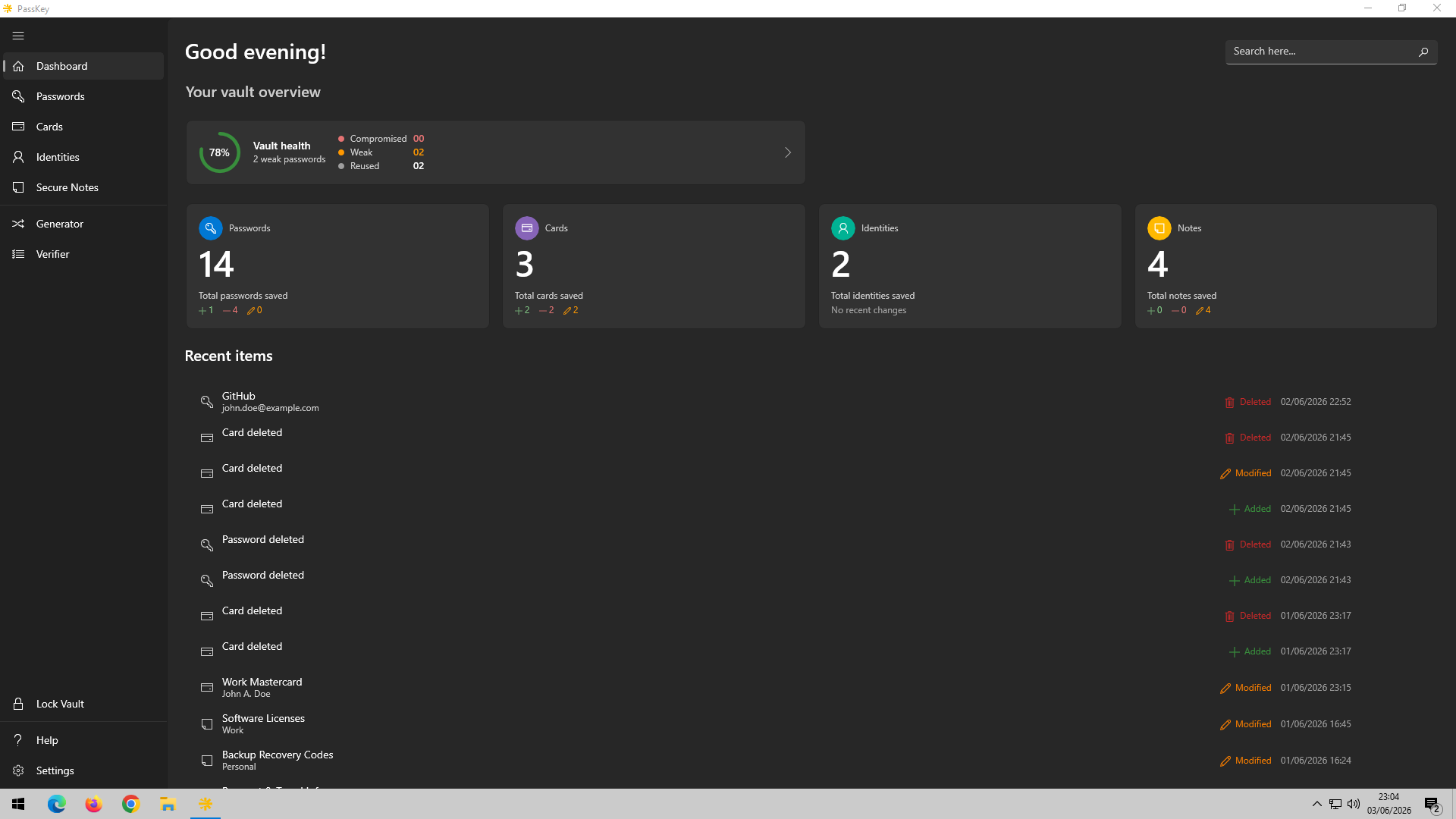
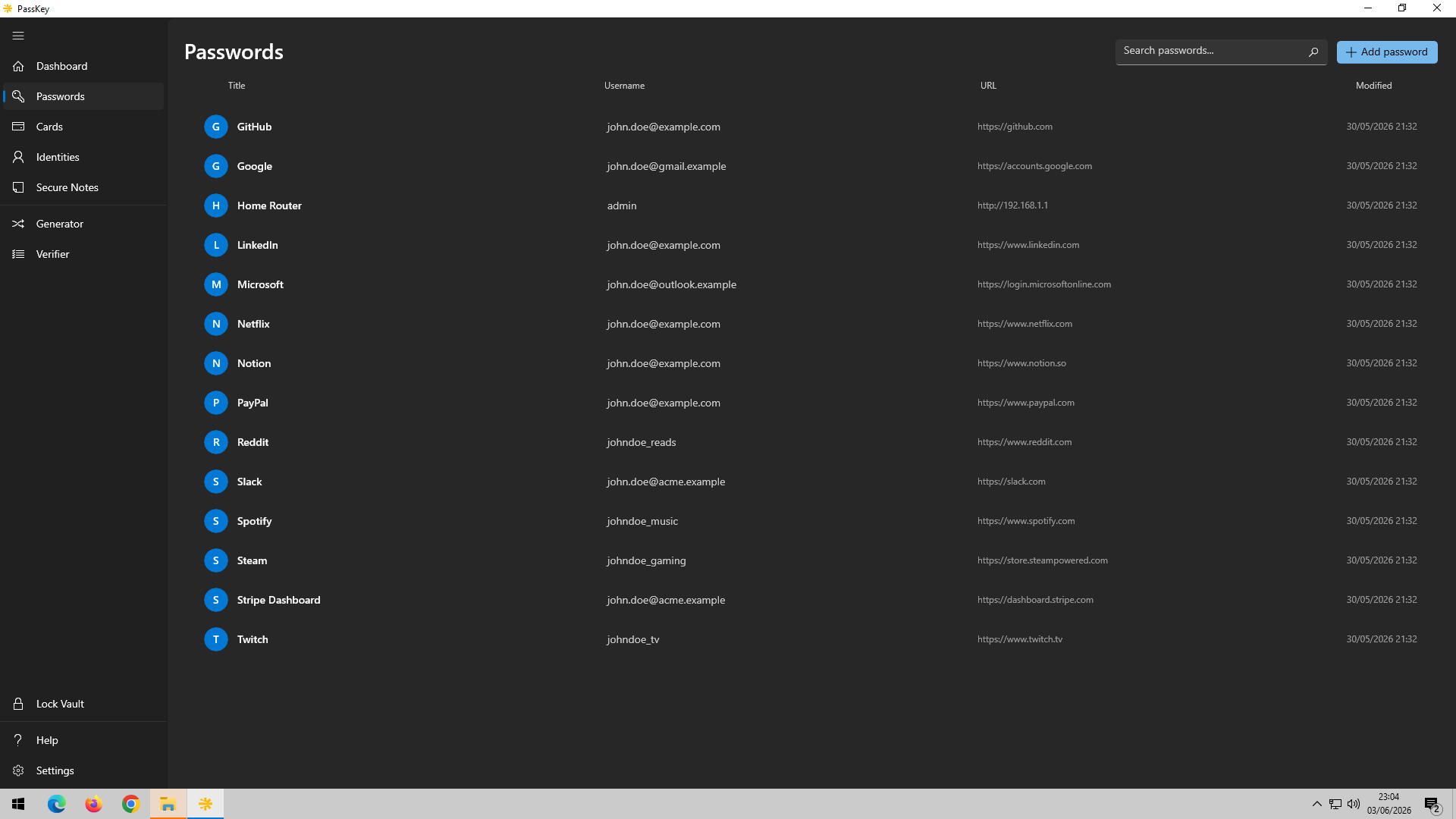
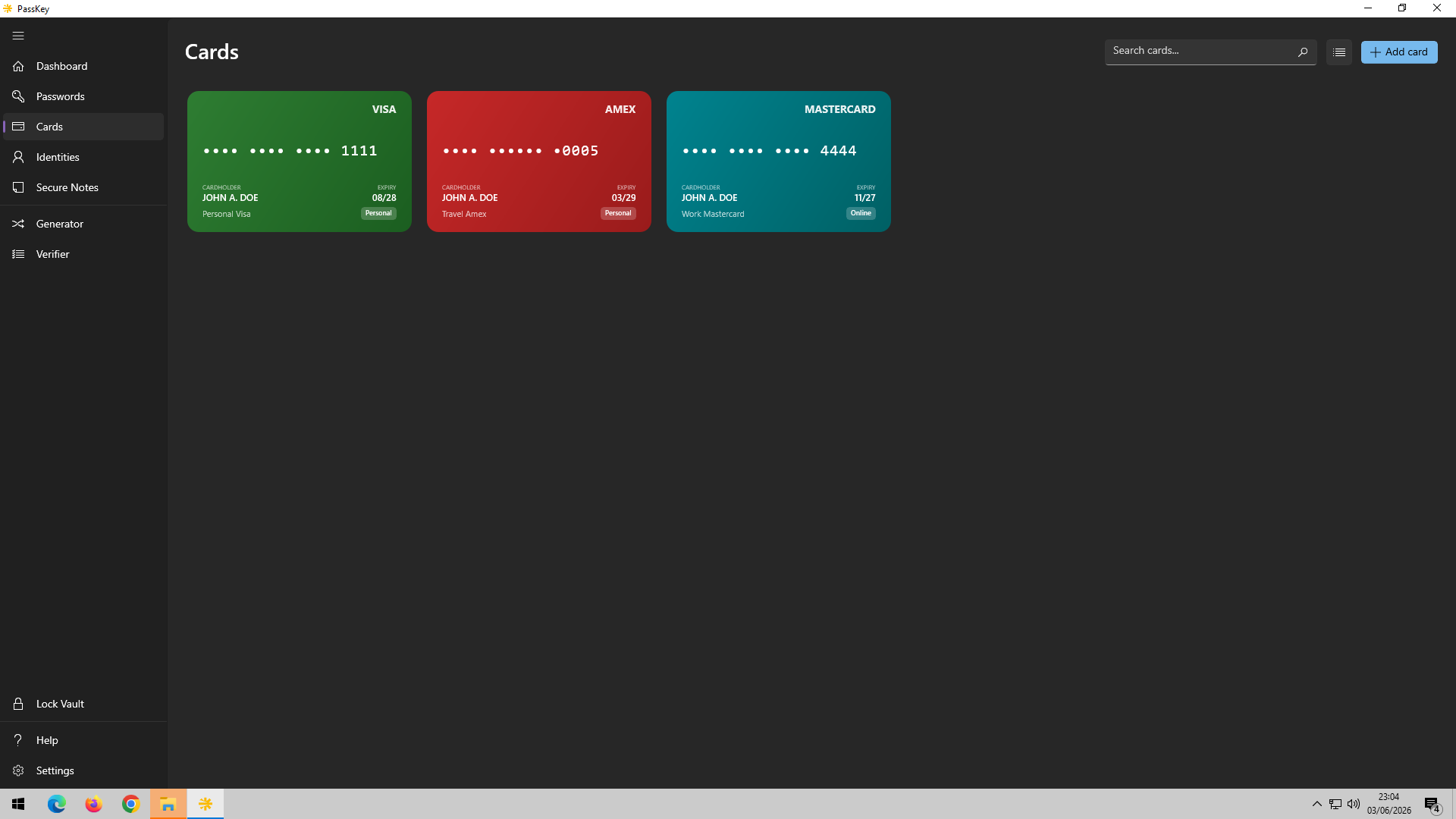
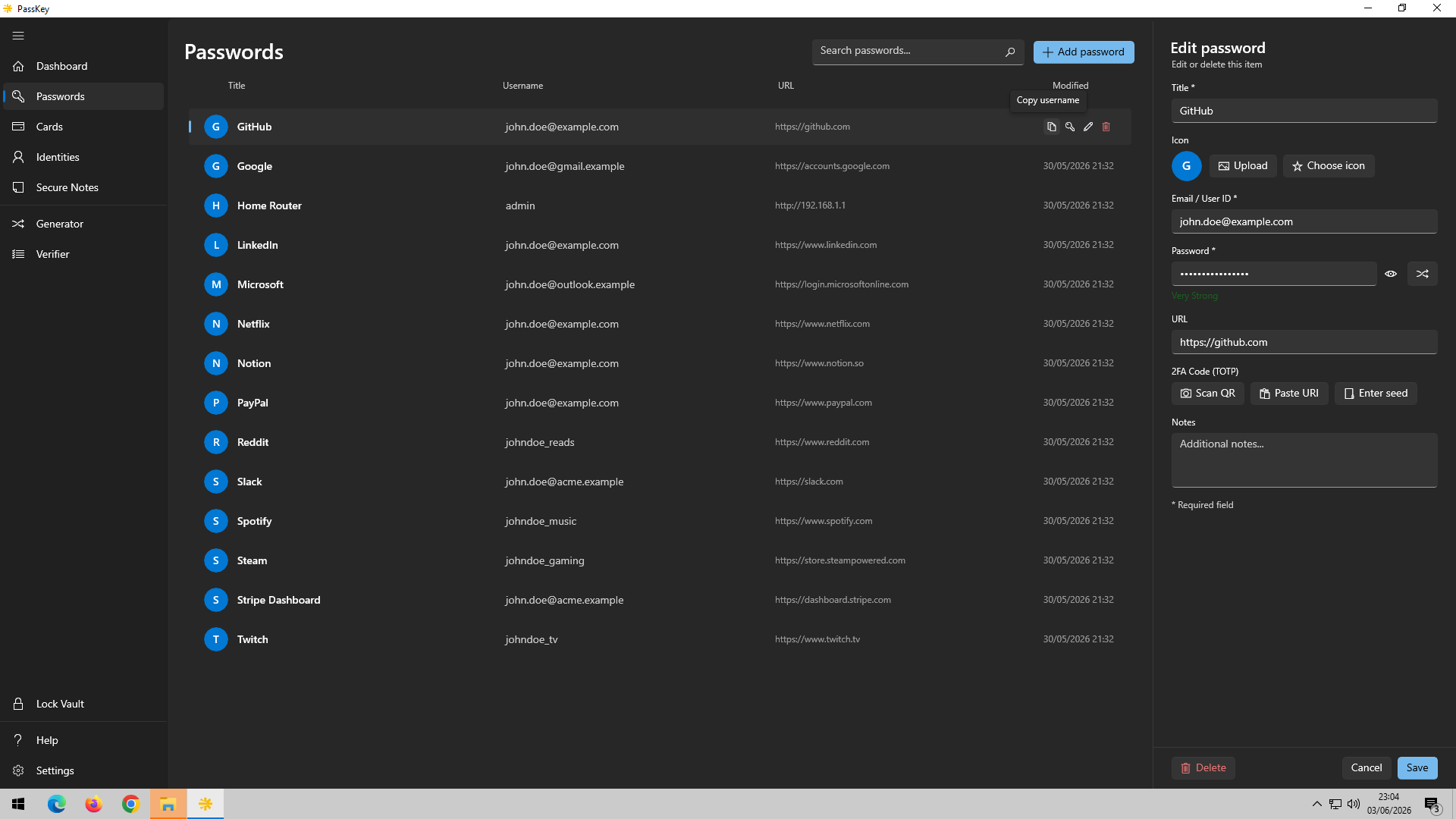
Does PassKey store passwords in the cloud?
No. PassKey is fully offline. Your vault is stored locally on your Windows device and is never transmitted to any server. There is no cloud sync, no telemetry, and no network requests of any kind.
What encryption does PassKey use?
Your passwords and data are protected by state-of-the-art encryption. PassKey encrypts every entry in your vault locally using AES-256-GCM with a unique nonce for each item. Your master password is never stored anywhere; instead, it is used to derive your encryption key using Argon2id (64 MB memory, 3 iterations, 4 threads). For backward compatibility, PBKDF2-SHA256 (600,000 iterations) is also supported.
Is PassKey free?
Yes. PassKey is completely free and open-source under the GNU General Public License v3 (GPL v3). There are no subscriptions, no premium tiers, and no in-app purchases — ever.
Which browsers does the extension support?
The PassKey extension supports Google Chrome, Mozilla Firefox, and Microsoft Edge. It communicates with the desktop app via native messaging — no credentials are sent over the network.
What are the system requirements?
PassKey requires Windows 10 version 1809 (build 17763) or later, 64-bit. The installer is self-contained — no .NET runtime or additional dependencies are required.
Can I import from other password managers?
Yes. You can easily import your credentials from other password managers like Bitwarden (JSON export) and 1Password (.1pux format). You can also import passwords exported from web browsers (Chrome, Firefox, Edge, etc.) via standard CSV files. Additionally, PassKey supports creating and restoring its own secure backup format (.pkbak), encrypted using Argon2id-AES-GCM.
Is PassKey open source?
Yes. PassKey is fully open-source under GPL v3. The complete source code is publicly available on GitHub and can be audited, forked, or contributed to by anyone.
Does PassKey sync between multiple devices?
PassKey does not sync automatically — this is by design, to keep your data local. You can manually transfer your vault by creating an encrypted .pkbak backup and restoring it on another Windows machine.
What happens if I forget my master password?
Because PassKey is fully local and offline, there is no central server, reset button, or customer support that can recover your password. Your master password is the only key that can decrypt your vault. If you forget it, your data is lost forever. We strongly recommend writing down your master password on a physical piece of paper and keeping it in a safe place.
Can I use PassKey on my mobile device (Android or iOS)?
Currently, PassKey is a native desktop application designed specifically for Windows 10 and 11, along with its web browser extensions. Mobile apps for Android and iOS are not available at this time. To access your passwords on other machines, you can manually transfer your vault via encrypted .pkbak backups.
Where is my vault database file stored on my computer?
Your vault database is stored locally in your Windows user profile folder under AppData (typically at AppData\Local\PassKey\vault.db). You can easily back up this file manually or include it in your system backups. Remember that this file is fully encrypted; it is completely useless to anyone who does not know your master password.